Showing posts with label Dental-Practice-growth. Show all posts

Thursday, 7 October 2021

Things You Should Know Before Setting Up Private Dental Practice


Things You Should Know Before Setting Up Private Dental Practice


Many of us are surrounded by people who have negative approach towards the Dental Profession. Staying arround such people... we also start to think negatively.


If you are looking for best second hand dental clinic equipment then visit our DentistFriend.com dental portal


I know dental profession is getting tough day by day. I agree salary of a BDS graduate is less than a labourer’s salary under MNREGA. I know PG seats are limited. Not only this but even after doing Postgraduation (MDS), the salaries in academics are shrinking these days. Dental Clinic is no more a cakewalk as everyone wants to start dental practice in a city which is already overcrowded with too many clinics. Many of you are leaving the profession to study MPH/MHA or to work at Pharmacovigilance data centers.


But still I believe that we are in one of the best professions in India. We are the Kings/Queens at our places of work. Do not loose your heart... Follow the 7 golden tips for successful Dental Practice.


1. Clinical Skills:


Master minimally in basic dental procedures before setting up your own practice such as Extractions, RCT, Esthetic Cosmetic Work, FPD, CD.


2. Invest Sensibly:


Whenever you open up your practice, do not waste your money much on interiors & show business initially. Instead invest in dental materials and equipments. Trust me nobody bothers it if you are good at your work. I have seen people investing 70% in showbiz & 30% on Dental materials/equipments.

Result: You know they cry after 6 months.


3. Have Patience: 


It will be fruitful only if you remain calm. Dentistry is like every other business. In the 1st year of your practice you pay from your pocket. In 2nd year you reach a break even point i.e there is NO PROFIT NO LOSS. Its only from the 3rd year that you start to earn. 


Suppose you are relocating after practicing for 4-5 years at some place; then regardless of your experience you will still have to have patience because your practice takes average 3 years to show profitability.


4. Keep Control on Yourself: 


Do not do Superman stuff in the initial years of your practice. Its very difficult to earn a name but very easy to spoil your name. Do case selection very effectively. If you don't have confidence about the case then either call a specialist or refer it to some experienced doctor. This way you might loose some money but you will make sure that it won't spoil your name.


5. Continue Learning: 


Attend CDE's & Conferences regularly. It will help you to remain confident of your profession and will also keep you up to the date with the new advances in the field.


6. Money Factor: 


Never underestimate youself. Charging less is not going to help you in long term. (Read The Price War In Dentistry By Dr.Pranav Agale). Never let the patient bargain; better let him/her go if he/she tries to bargains. Most of them will come back to you for the treatment at your described costs within a week after visiting 2-3 clinics in their vicinity. Always remember good things never come cheap.


TELL ME IF ANY PATIENT BARGAINS WITH AN EYE SURGEON OR  A HEART SURGEON? THEN WHY US???


7. Marketing: 


Do regular marketing for your clinic. Because your clinic is just like a CORPORATE firm and you are the boss (MD).  So you have to do all sorts of advertisements (ofcourse ethically) to let patient's know that YOU EXIST.


MORE INPUTS FROM SENIORS AND FRIENDS ARE WELCOME.


Source : DentistFriend

How To Build A Successful Private Dental Practice?


How To Build A Successful Private Dental Practice?


Years back dentistry used to be a profession of a few but it has become one of the most prolific career option now a days. Today's dental graduates are under far more stress compared to their seniors few years back.


DentistFriend.com is a dental portal to conduct educational programs dental fraternity on practice management workshop, dental practice marketing.


I have tried to outline some basic causes that lead to stress and their remedies. Take care of these facts of life and you will notice your dental life getting on track.


1. Get rid of the POW


     P = PRESUMING

    O = OVER IMAGINATION

    W = WORRY


If you are a new graduate, you will agree that dentistry has become a crowded place but that doesn't at all mean that you can't make name & fame. Of course it might take a bit longer than it used to..


So when you enter into private practice don't over imagine that things will fall in to place and you will be in immediate demand; instead be ready to take it day by day!


Remember it’s a game of patience; worrying is not the solution. Rather it is better to set goals and try to achieve them.


I'm sure that sooner or later you will agree with my point. 


2. Count your chickens before they hatch


Dental profession requires investment of both your time & money. Not only you have to invest in studies but also in establishment of clinic & this financial investment never end.


You should have a target on where you want to be in specific period of time i.e. Time: Money balance.


Spending beyond what you have can be a very risky proposition. Financial debt is one of the biggest reasons of stress for many. Remember it’s your or your parent’s hard earned money, so plan precisely and manage your funds properly and never spend on anything just because some of your colleague did it.


3. Work Life Balance


Family is the fulcrum between your personal & professional life. In the pursuit of professional success, never let go of the family. Because- "Success in dental practice" is directly proportional to time you spend with your family whereas "Stress" is inversely proportional to time you spend with family.


The less time you give to your family the more stressful dentistry will feel to you. You need motivation to succeed & there can’t be stronger motivation than to work and improve the life of your family members both professionally and personally.


4. Don’t Just Live- Be Alive!


It is good to chase your dreams but do not forget that "A healthy mind resides in a healthy body". Dentistry is tough on body; with age there are chances of back pain & fatigue creeping in. Take some time out of your busy schedule for yourself. Divert yourself from dentistry; spend some time for your hobbies. Hobbies are the great stress busters; it can be anything singing, photography, travelling, dancing, cooking or anything… but spend some time with yourself  


These activities reduces your stress & helps you in reaching the professional excellence


5. Take It Easy


There will be a lot of people around you who won't stop criticizing dental profession but take it easy! Don't overreact to such cynic personalities! That will save you from a lot of stress.


There is nothing wrong is discussing negative aspects of field. That in a way keeps you informed about the possible problems in your profession and eventually you might come out with some solution..


6. Follow "No Comparison" Policy


A lot of dentists have the habit of comparing themselves with graduates of other streams. This comparison is of no use; it won’t do anything than adding further stress to your life.


So get out of it; stop comparing & if you can’t stop comparing yourself with other professionals; it is better to get out of dentistry. Also learn to be grateful in life, be thankful for what all you have and then work hard for more.


You must have heard the saying


"Work with an aim on the target but not worrying about the target"


CONCLUSION:


Well then my dentist friends! These are some of the mantras I learned about dental life from my seniors and staffs and they learned it after years of struggle. These positive habits can't be acquired overnight but are as practical as sun rising in the east everyday!


Remember! to be successful in dental career, you need to have the power to tackle the stress and now you know how to!


Feel Good, Live Good, Do Good: Happy Dentistry! All the best for a successful dental career. 


Source : DentistFriend

Clinical Dentistry Tips: 3 Keys To The Perfect Bisque Trial


Clinical Dentistry Tips: 3 Keys To The Perfect Bisque Trial


On one end of the ladder is leaving the crown high and telling the patient “Settle ho jaega” and on the end is over reducing the prosthetic crown thinking “yeh supraerupt hoke contact mein aa jaega”


DentistFriend.com is an exclusive dental portal for budding dentists and dental professionals where you can search jobs or hire dentist for clinic


Unfortunately both these can have long term deleterious effects on the patients dentition and thus we clinicians should refrain from such erroneous practice.


As ethical clinicians, it is imperative that we do not introduce any interference in the patient’s mouth when crowning a tooth and this makes adjusting the occlusion at the bisque trial phase one of the most critical steps in fixed prosthodontics.


Occlusion at bisque trial should be adjusted in two separate steps:


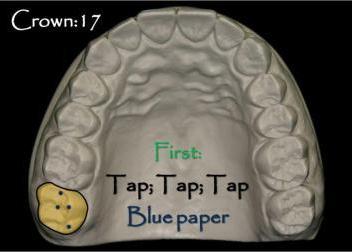
1. Static Occlusion: Where the bite is adjusted in Maximum Intercuspation with POINT contacts on functional cusp tips, mesial/distal marginal ridge and/or central fossa only. 

This should ideally be done with 40 micron Blue colour articulating paper.


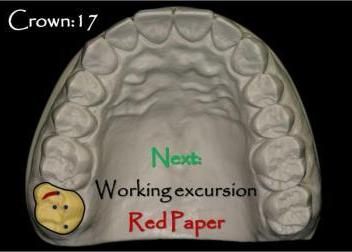
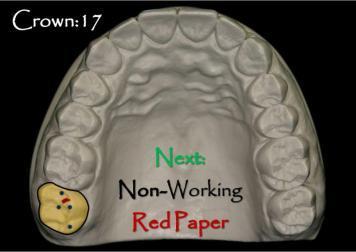
2. Dynamic occlusion: Where excursive contacts are checked (in working side excursion as well as non-working side excursion) and any LINE markings are eliminated completely. It is important to remember that posterior teeth should contact only during Maximum Intercuspation and should be completely disoccluded in every excursive movement.


This should ideally be done with 40 micron Red colour articulating paper


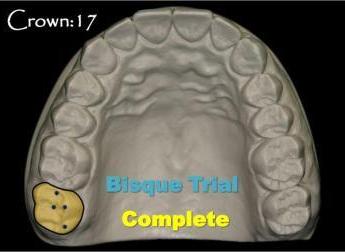
Let’s see how to go about doing a Bisque trial for tooth number 17 diagrammatically.


 First static occlusion is adjusted to achieve 4 points of contact in MIP using blue paper.


Next with red paper working excursion is checked. As depicted a line is seen on the buccal cusp. This line is a working side interference and thus should be completely eliminated.


 Following this the non working excursion is checked and any red line marking is eliminated.


This concludes the bisque trial and the crown is now ready for glazing.


 ”Dots at the Back and Lines in the Front” is the key to achieving an interference free occlusion.


Source : DentistFriend

Wednesday, 6 October 2021

How To Deal, When You Are Asked For Guarantee On Dental Implants?


How To Deal, When You Are Asked For Guarantee On Dental Implants?


In initial days of my practice, one of the patients asked me “Doc, this implant would last lifetime, right?”  I was surprised with that sudden question.. I was really not used to all such bouncers but somehow I managed the situation of that time. The whole incidence had left me with the fear of facing such questions in future and that's when I decided to get answers to all such questions..


DentistFriend is a dental portal for dental students and dentists with exclusive services for dental industry such as jobs, resale clinic equipment, etc .


The first thing that I tried to figure out was "Why do patients ask for guarantee of implant?" & I found the answer when I looked at the treatment option with patient’s perception. It is not that patients always ask for guarantee due the high treatment costs but sometimes it's due to the fear of surgery.


What patients ask is not wrong but as a clinician one should never forget that even after having best of knowledge, skills and vast experience, many things can go wrong and implants can fail. 


What best a clinician can do is; assure patient that things are done to the best of his knowledge, skills and experience; treatment results may last longer, subject to patient’s awareness, motivation and desire to follow clinician’s instructions and regular recall visits.


The word Guarantee is really dangerous.. 


As it literally means “promise” or “pledge”. How a doctor who is treating human body part (that is regulated by so many factors) can give LIFETIME GUARANTEE on a specific treatment.


"Guarantee" is fine with non-living objects but doesn't it sound weird with respect to living things?


Have you ever heard any experienced Cardiac Surgeon saying, “I have done a fantastic bypass surgery, now I guarantee you 10 years or 20 years of life”, probably you will never ever hear this. Forget about the cardiac surgeon even the Almighty has not given a guarantee of life. In my humble opinion “Guarantee” is not a word that should exist in the dictionary of a doctor. Being clinicians we all know that human body has complex mechanisms where many things are in simultaneous process. Above all every person reacts differently (Including both doctor and patient) in different situation so nobody can predict the longevity of treatment. 


In my practice there is absolutely no word called GUARANTEE, for your surprise some patients have even challenged me by saying, “Doctor if you can't give guarantee means you don’t trust your skills, My polite reply to that was, "Sir I do trust my skills more than anything but what I don’t trust is YOU”


Overall studies have quoted success rate of single implants for more than 97% up to 10 years (less for implant supported full arch prosthesis), So that is what we can call life of an implant. After good surgical placement & implant prosthesis, If implant survives more than 10 years it would be all because of good maintenance and periodic recall visits kept by patient. 


Patients expect implant to survive till they die, which is not possible anyway. We need to make it very clear at consultation phase only that life of an implant would be up to 10 years sometimes it may be less than that (depending upon patient’s local & systemic conditions also).  I always tell my patients, “Huge amount that you are going to spend for an implant and using that implant all day for another 8 to 10 years, is a very long span, so spending on implant is completely worth; rather looking at the cost, look at the benefits like quality of oral functions you are going to get after dental implant treatment.


I never forget to mention that implant structure includes screw and crown, so there are equal chances of screw loosening and some damage or fracture to prosthetic structure due to wear and tear which can be managed subsequently with an additional cost. In case of an Implant failure, most suitable option at time would be suggested like an implant placement again or some alternative option with a reasonable cost. Never ever convince patients on the basis of promises that are beyond your control, be realistic and straightforward as it will give you long standing trustful relation with your patient and above all complete peace of mind

And last but not the least; don’t forget to tell your implant patients…


“Implants are lifeline but not for lifetime”. 


I wish you all a very Happy Implant Dentistry.


Source : DentistFriend