Showing posts with label Clinical-dentistry-Tips. Show all posts

Thursday, 7 October 2021

Clinical Dentistry Tips: 3 Keys To The Perfect Bisque Trial


Clinical Dentistry Tips: 3 Keys To The Perfect Bisque Trial


On one end of the ladder is leaving the crown high and telling the patient “Settle ho jaega” and on the end is over reducing the prosthetic crown thinking “yeh supraerupt hoke contact mein aa jaega”


DentistFriend.com is an exclusive dental portal for budding dentists and dental professionals where you can search jobs or hire dentist for clinic


Unfortunately both these can have long term deleterious effects on the patients dentition and thus we clinicians should refrain from such erroneous practice.


As ethical clinicians, it is imperative that we do not introduce any interference in the patient’s mouth when crowning a tooth and this makes adjusting the occlusion at the bisque trial phase one of the most critical steps in fixed prosthodontics.


Occlusion at bisque trial should be adjusted in two separate steps:


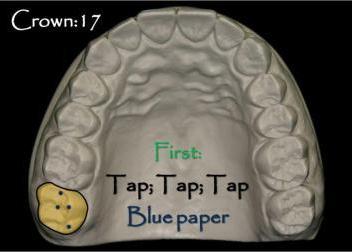
1. Static Occlusion: Where the bite is adjusted in Maximum Intercuspation with POINT contacts on functional cusp tips, mesial/distal marginal ridge and/or central fossa only. 

This should ideally be done with 40 micron Blue colour articulating paper.


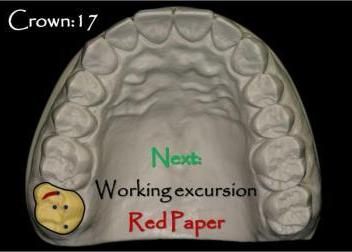
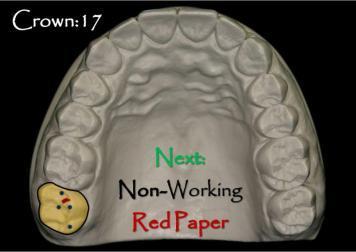
2. Dynamic occlusion: Where excursive contacts are checked (in working side excursion as well as non-working side excursion) and any LINE markings are eliminated completely. It is important to remember that posterior teeth should contact only during Maximum Intercuspation and should be completely disoccluded in every excursive movement.


This should ideally be done with 40 micron Red colour articulating paper


Let’s see how to go about doing a Bisque trial for tooth number 17 diagrammatically.


 First static occlusion is adjusted to achieve 4 points of contact in MIP using blue paper.


Next with red paper working excursion is checked. As depicted a line is seen on the buccal cusp. This line is a working side interference and thus should be completely eliminated.


 Following this the non working excursion is checked and any red line marking is eliminated.


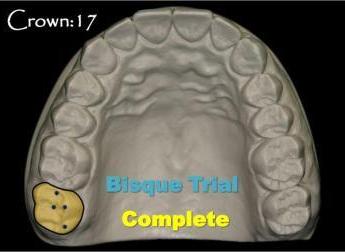
This concludes the bisque trial and the crown is now ready for glazing.


 ”Dots at the Back and Lines in the Front” is the key to achieving an interference free occlusion.


Source : DentistFriend

Dental Photography: Are You In Focus?


Dental Photography: Are You In Focus?


Despite having innumerable hours of experience with shooting I have met many dentists who pursue dental photography in the AUTO mode.

I have nothing against the use of AUTO mode but I feel there is a HUGE need for the dentists (AND OTHER MEDICAL EXPERTS) to understand that by using the camera in auto mode one fails to realize the true potential of ones DSLR (or other camera) The AUTO mode is nowhere close to what a DSLR camera can really achieve.


How much does it cost to become a dental photography courses in india to know visit our dental portal DentistFriend


It’s actually like a monotonous robot who fails to have a mind of his own.NO creativity, No BRAIN, NO Ambition and NO experimentation … what a dull life.

Despite being a boring mode to shoot in the AUTO mode has innumerable drawbacks one of the greatest drawbacks being the loss of freedom to choose the right focus point.


This post shall be helpful to all the beginners in dental / medical photography who want to understand WHY despite innumerable attempts they do not get a sharp image in any particular situation”

It’s invariably important to have a rough idea of the composition of an image in your mind, not a difficult job for a dentist considering we have few options for standard type of photography. (Of course if you would like to be creative Sky is the limit … but that’s not the point for this post)


We now have a set composition and a magnification to shoot at. We know the settings to shoot at.


The Next step is to focus accurately.


In semiprofessional cameras there is a box (actually meant for face recognition) to help you focus on the area of interest.


In AUTO mode this box tends to change place and even before the dentist knows the box shifts to a place which the camera feels is the desired region for focus and the result is a blurred image.

The reason for this is that the camera will focus on the easiest spot as soon as possible and this usually is a well-lit area with high contrast (be it intra oral or extra oral photography) this area need not be the area where the dentist wants to focus.


So is there a way the dentist can change the focus spot? The answer is yes

In semiprofessional cameras too you can switch to manual focus and manual mode of shooting and shift the box to where exactly you would want to focus.


Remember SMALLER the box … greater will be the accuracy of the spot where you would like to focus.

Speaking about DSLR we have a much professional way to solve the issue

Every DSLR has specific focus points (Number of focus points - 9, 11, as many as 100 or more)

A dentist can pre-select the focus point of choice based on the composition of the image in his/ her mind.


For e.g., selecting the top focus point instead of the center focus point might give greater sharpness to the central incisors which are the subject of conversation in the image.


The focus point can be easily selected using the main dial in Canon cameras. The focus point selected turns RED in the optical viewfinder and also on the LCD screen.

The only thing left NOW is to shoot … hey but wait a minute … we have still not finished actual focusing.

It is always a good choice to set magnification first in the camera and set the lens and camera to manual mode and manAnchorual focus.


Before pressing on the shutter release button one has to make sure that the desired spot is accurately in focus in the optical view finder

If it is not in focus at the desired magnification it is ALWAYS recommended to move your own position rather than change rotate the lens for focusing because that will again change the magnification ratio.


In canon cameras once we achieve accurate focusing the camera gives out a small beep and the focus point flashes red again when we HALF CLICK

(Half clicking is a very good habit that needs to be cultivated because this will tell us if we are correctly focusing or not)

I used a Nikon camera and surprisingly Nikon camera did not give out a BEEP in manual mode during half click – I was a bit uncomfortable with that.


Lastly we need to understand that Focus point is the center of an imaginary sphere (of focused area) Maximum sharpness is in the center and focus reduces as we come towards the periphery.

Hence we should always focus in a spot in between the desired area of depth of field

E.g If we want the entire upper arch in focus it is a good idea to focus on Canines rather than the incisors to avoid wastage of the sharpness in depth of field


Source : DentistFriend

Wednesday, 6 October 2021

How To Deal, When You Are Asked For Guarantee On Dental Implants?


How To Deal, When You Are Asked For Guarantee On Dental Implants?


In initial days of my practice, one of the patients asked me “Doc, this implant would last lifetime, right?”  I was surprised with that sudden question.. I was really not used to all such bouncers but somehow I managed the situation of that time. The whole incidence had left me with the fear of facing such questions in future and that's when I decided to get answers to all such questions..


DentistFriend is a dental portal for dental students and dentists with exclusive services for dental industry such as jobs, resale clinic equipment, etc .


The first thing that I tried to figure out was "Why do patients ask for guarantee of implant?" & I found the answer when I looked at the treatment option with patient’s perception. It is not that patients always ask for guarantee due the high treatment costs but sometimes it's due to the fear of surgery.


What patients ask is not wrong but as a clinician one should never forget that even after having best of knowledge, skills and vast experience, many things can go wrong and implants can fail. 


What best a clinician can do is; assure patient that things are done to the best of his knowledge, skills and experience; treatment results may last longer, subject to patient’s awareness, motivation and desire to follow clinician’s instructions and regular recall visits.


The word Guarantee is really dangerous.. 


As it literally means “promise” or “pledge”. How a doctor who is treating human body part (that is regulated by so many factors) can give LIFETIME GUARANTEE on a specific treatment.


"Guarantee" is fine with non-living objects but doesn't it sound weird with respect to living things?


Have you ever heard any experienced Cardiac Surgeon saying, “I have done a fantastic bypass surgery, now I guarantee you 10 years or 20 years of life”, probably you will never ever hear this. Forget about the cardiac surgeon even the Almighty has not given a guarantee of life. In my humble opinion “Guarantee” is not a word that should exist in the dictionary of a doctor. Being clinicians we all know that human body has complex mechanisms where many things are in simultaneous process. Above all every person reacts differently (Including both doctor and patient) in different situation so nobody can predict the longevity of treatment. 


In my practice there is absolutely no word called GUARANTEE, for your surprise some patients have even challenged me by saying, “Doctor if you can't give guarantee means you don’t trust your skills, My polite reply to that was, "Sir I do trust my skills more than anything but what I don’t trust is YOU”


Overall studies have quoted success rate of single implants for more than 97% up to 10 years (less for implant supported full arch prosthesis), So that is what we can call life of an implant. After good surgical placement & implant prosthesis, If implant survives more than 10 years it would be all because of good maintenance and periodic recall visits kept by patient. 


Patients expect implant to survive till they die, which is not possible anyway. We need to make it very clear at consultation phase only that life of an implant would be up to 10 years sometimes it may be less than that (depending upon patient’s local & systemic conditions also).  I always tell my patients, “Huge amount that you are going to spend for an implant and using that implant all day for another 8 to 10 years, is a very long span, so spending on implant is completely worth; rather looking at the cost, look at the benefits like quality of oral functions you are going to get after dental implant treatment.


I never forget to mention that implant structure includes screw and crown, so there are equal chances of screw loosening and some damage or fracture to prosthetic structure due to wear and tear which can be managed subsequently with an additional cost. In case of an Implant failure, most suitable option at time would be suggested like an implant placement again or some alternative option with a reasonable cost. Never ever convince patients on the basis of promises that are beyond your control, be realistic and straightforward as it will give you long standing trustful relation with your patient and above all complete peace of mind

And last but not the least; don’t forget to tell your implant patients…


“Implants are lifeline but not for lifetime”. 


I wish you all a very Happy Implant Dentistry.


Source : DentistFriend

5 Things To Consider Before Joining Courses At Any Dental Academy


5 Things To Consider Before Joining Courses At Any Dental Academy

Now a days as the level of Dental Education in some Indian Dental Schools is all time low.  There are some responsible experienced dental professionals who have come forward to guide young dental graduates. But unfortunately not many are able to stick to the original motive of imparting dental education and it is becoming more of a kind of business.


Visit our DentistFriend.com dental portal to write blogs and participate in discussion forums. 


Irony is that these days one has to take coaching for cracking premedical entrance exams to become a doctor and later they have to again take coaching even after graduating as Dental Surgeons.


If you go to any dental event or dental conferences and you will find some people standing at the entrance of venue distributing leaflets of various Dental Academies. The most funny/sad part is that some of these academies are being run by freshly pass outs and they are teaching subjects which need vast experience of over the years to master. PLEASE BEWARE OF THEM.


For example, How come you expect to learn Oral Implantology from someone who himself has not placed even 100 implants? Does he know the failures? As they say, Master has failed more times than the beginner has even tried. 


My point of writing this blog is to share my personal experience that may help you in deciding from which right place to learn. Definitely we all need to learn and upgrade ourselves from time to time. So, here are the top 5 points to consider before joining any academy:


1.  Get reviews from your friends, college teachers, internet and check yourself which one is most liked and reasons behind it and then only make a decision. Never make a decision to join any academy considering your convenience rather give priority to best learning experience. Learning will never come easy, be always ready to leave your comfort zone, no matter even if you have to travel PAN India.


2.  Don't join academies mentored by any Novice. A novice can teach in right fashion and may know the Ideal work but he won’t be able to teach you the failures for sure as he himself is not aware as have not encountered many in his short tryst with the subject.


For example: Learn Oral implantology from a mentor who has done more than 1000-1500 implants over 10-15 years. i.e. now he/she is a speaker of International repute. He/She has seen the failures and will be able to teach you how to overcome them.


3.  It hardly matters whether your mentor is a BDS or MDS. This should not be your criterion of selection. Count the number of years of their practice and not degrees. Degrees do have a value but they don't matter much in this aspect. Many big names in this field are old time plain graduates who have done unofficial masters in clinical procedures at their own clinics.


For instance, one of my good friends is a pioneer in teaching micro-endodontics in a North Indian city near National Capital. He himself is a BDS graduate but has many endodontists in his fan list.


4.  Don't go for fancy courses, particularly Orthodontics courses. No doubt a BDS can practice orthodontics but that is possible after proper orthodontic training. Ortho is a very vast science in which prognosis is majorly based on treatment planning & how can you even expect to learn treatment planning in 5-10 days? Which otherwise needs 3 years.


I recently met someone who was repenting of wasting his energy and resources for doing a 7 day short ortho course and finally he has to call an Orthodontist for consultation.


5.  Lastly and most importantly. Choose the courses in which you have more number of patients to do than just the theory part. You always have Google option for theory and demo Videos.


I hope these points will help you in your selection of right course and academy.


Please Note: Further inputs from seniors in profession and friends are most welcome.


Source : DentistFriend