Thursday, 30 September 2021

How To Choose Your Air-Rotor Handpiece?


How To Choose Your Air-Rotor Handpiece?

Air rotors are honourably the extension of a dentists working hand and the clinician today is extremely dependent on the optimal performance of his/her rotors to ensure a smooth functional practice. The dental handpiece of today is a sophisticated amalgamation of precision parts moving in seamless synchronization at extremely high speeds. This arrangement delivers a smooth, powerful cut that allows the clinician to stroke through hardened tooth structure with ease, leaving a smooth, clean preparation margin, with reduced trauma to the patient and the clinician.


How much dental courses cost in india, to know visit our dental portal.


Let us understand a little about how to choose an airrotor handpiece.

In order to be able to choose the correct high speed airrotor for the practice; it is imperative to understand:

a. The anatomy of the airrotor

b. How the airrotor functions


a. ANATOMY OF THE AIRROTOR

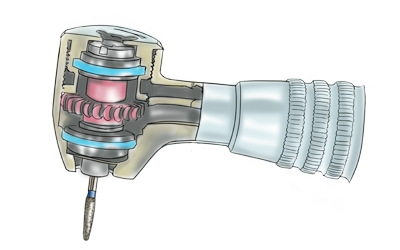
An airrotor consists of two main components: The outer shell, and The inner turbine


1. Outer Shell

The outer shell is the long tubular portion that makes up the body of the instrument. This outer shell is further divided into head and sheath. The head holds the turbine and sheath forms the handle that harbours the air and water supply.
Outer shell is made in one of three materials:

Material

Advantage

Drawback

Brass

Inexpensive material

Easy to machine

Soft material

Susceptible to easy denting

Stainless Steel  (SS)

Lighter than brass 2956

Stronger than brass

Higher manufacturing costs

Titanium

40 percent lighter than SS

Stronger than SS

Greater corrosion resistance than SS

Cost


2. The inner turbine cartridge

The inner turbine cartridge is the workhorse of the handpiece sitting encased within the head of the outer shell. The rotary system consists of an impeller / rotor mounted on a spindle/chuck assembly supported on either side by precision ball bearings and suspension O-rings.


b. HOW DOES THE AIRROTOR FUNCTIONS?

As air from the compressor is introduced into the handpiece via the foot pedal, it gushes through the airline attached to the back end of the handpiece (i.e. coupling); from where it goes up through the handpiece shell into the head and is forced over the impeller of the turbine. As the impeller catches this air, it begins to rotate clockwise at high speeds causing the spindle to rotate with it (like a wind mill). The bur is physically locked into this spindle/chuck assembly thus allowing drive air energy to be productively converted into rotary motion setting the bur running.


Turbines rotate at speeds of about 400,000 rpm, faster than anything else on the planet. It is important to understand that not all these rotations reach the tooth.


Turbine speeds are categorized as free speed and active speed. Free speed is the maximum rpm with no load (bur is running free in air). Active speed is the actual speed the turbine is reduced to when the bur contacts the tooth structure (bur is actively engaged against the tooth). Most air rotors have an active speed in the range of 180,000 to 200,000 rpm (about half of the free speed) depending on the contact pressure. This is where the torque of the handpiece comes into picture.


“Torque” is the measure of the hand piece’s ability to remove tooth structure. The greater the torque available to operate the cutting instrument, the less physical demand is placed on the operator’s hand and wrist.


HOW TO SELECT AN AIRROTOR FOR YOUR PRACTICE?

When selecting an airrotor always keep patient and personal wellbeing at the forefront. Investing in an initial cost effective handpiece system may compromise patient health and invite occupational hazards. Cheap air rotors may quickly add up to become a significant capital expense in the form of repair costs.


Few factors one must consider when selecting an airrotor are enlisted below:


1. Head Size:

There are several head sizes of high speed handpieces available ranging from 9.8 x 8.5 mm to 14.5 x 13 mm. Most manufacturers offer different models featuring a large and a small (miniature) head design.


Small head sizeimproves visibility and access, especially in the posterior region and with children. However when a long bur is used in a small head airrotor; it can exert significant lateral stresses on the turbine reducing the life expectancy of the cartridge.


Larger head size: incorporate a larger turbine impeller with higher torque and power output. More cutting power equals less time involved in tooth preparation.

It is best to keep one of each head sizes; using the large head more routinely and switching onto a miniature head as and when access or visibility becomes a concern.


2. Head angulations:

The typical handpiece head is angled back at 22.5 degrees. This ensures that the bur remains in line with the clinician’s sight. However, this can sometimes restrict access to posterior teeth (especially distal of maxillary second molars) by causing the back end of the handpiece head to come in premature contact with teeth in the opposing arch.

Newer designs feature a unique head angle to increase posterior access and patient comfort.


3. Types of tubing connection:

The base of the handpiece has holes; each of which serves a specific function

2 hole handpiece: Usually the standard in India where the large hole is for air and the smaller hole is for water. As there is no port for used air to escape such airrotors are loud.

4 hole handpiece: Usually the standard in the U.S. and Europe. It has two large holes for air intake and air escape which ensures less noise and allows the bur to halt faster upon releasing the foot pedal. The other holes serve the function of water intake and chip air which ensures the water jet escape as fine mist and not water droplets.

A simple coupler can be used to help convert a 2 hole handpiece into a 4 hole one.


4. Bur retention mechanism:

Standard Screw-Type: The spindle and chuck are separate and a chuck device is used to insert and remove the bur

Push Button-Type: The spindle and chuck are a single assembly and a push button cap on the handpiece head is used to open or close the chucking mechanism. This is easy to use and time saving.


5. Ball bearing material:

The heart of the turbine is the delicate ball bearings. Usually fabricated in either stainless steel or ceramic. Ceramic is usually the preferred choice as it is harder, weighs less with greater abrasion resistance and thus longer life expectancy.


6. Ergonomic Design:

The handpiece holding time (number of minutes the clinician spends holding a handpiece) constitute a significant portion of a functional day, and over the course of a career, long-term occupational hazards may manifest from holding an imbalanced airrotor.

When held in the functional position the balance of the handpiece should be neutral or slightly towards the handpiece head. A heavy handpiece may lead to early fatigue during procedure. Manufacturers are trying to work with lighter weight materials especially for the shell to help decrease the overall load on the clinicians hand when working for long hours at a stretch.

Handpiece shell can be either knurled or smooth. Most clinicians prefer the knurled finish as it improves grip with gloves. It is important that the knurling not be too deep or too close so as to compromise handpiece cleaning and sterilization


7. Water Delivery:

A water jet helps keep the prepared tooth cool and the helps evacuate debris from the work field. A multiport (usually three to four) spray emanating from the face of the handpiece is far superior then a single water port as they have a significantly higher cutting rate.

The multiport provides even distribution of coolant water over the entire surface of the tooth and prevents the water spray from being blocked when preparing the distal surface of a tooth or while removing temporary restorative material from an endodontic access cavity (a common problem with a single water vent).

The direction of water spray is very important. An ill directed port shoots water off the bur and air becomes the coolant which is ineffective in dissipating heat.


8. Light source:

Improved visibility of the treatment site is always desirable. Instruments with an integrated light source, which illuminate the treatment site directly, have massive impact on the quality of treatment rendered to the patient.

Handpieces are one of the most important workhorse systems in the dental practice. They have received immense attention in the recent past and never materials and techniques for fabrication show promise towards increasing functional harmony and longevity of these instruments.

Regardless of quality and price; logical reasoning behind choice of a high speed handpiece and a diligent maintenance protocol can go a long way in ensuring seamless functioning and quality driven dentistry. This article describes a few important aspects to be considered when choosing an airrotor handpiece.


How to write blogs for your dental practice?


How to write blogs for your dental practice?


In the 1st part of this series, I answered some frequently asked questions like, 
 

1. What is a blog? 

2. How blogging can help to grow your practice? 

3. How to create a blogger account?


Visit DentistFriend.com dental portal to manage dental clinic plan.


Now in this part let's understand how to write a blog for your dental practice. The 1st question that will have is What to write? You can simply write about treatments that you offer or any particular case that you did and any other topics related to dentistry that you think defines your practice.


How to write blogs for your dental practice?

If you are completely clueless on how to write then you can follow the trick that I use. Every story or a blog has 4 components

1.Problem

2.Body

3.Solutions

4.Happy Ending


Now let’s see, How to use these components for writing a blog post?

1.Start the blog post with the problem i.e patient’s chief complaint

2.In the body, write about treatment options

3.In solution write about the treatment you did

4.In the end write about patients feedback


When you write a blog post make sure it is short, sweet and is easy to understand. To make it further easy, during consultation you can record the conversation between you and your patient on your smart phone. Later you can convert the recorded audio file into a text file with free online tools. After which all you have to do is little bit of editing & you are done!


Friends this whole process doesn’t even take half an hour, if you could do it for at least one case every month, you will have 12 blogs published by the end of year. It’s simple easy and free, that will open new doors for your practice!


You can download the blogger application from play store or app store to continue writing on the go. You can also track visitors on your blog by integrating it with Google Analytics.


The Gabbar Way Of Dental Practice Management!


T
The Gabbar Way Of Dental Practice Management!


Gabbar Singh was a TRUE MANAGEMENT GURU as is reflected in some of the timeless management lessons he delivered through the movie Sholay. Friends these lessons can be used effectively in order to build and maintain a successful dental practice. Read On...They are awesome..!


Visit our dental portal to write blogs and participate in discussion forums.


1. Jo Darr Gaya - Samjho Mar Gaya!

Courage and enterprise are important factors for laying the successful foundation of a growth oriented dental practice. If you continue worrying about scenario of private dental practices then there are more chances that you will end up with problems. So it’s better that you buckle up and get ready for some calculated risks, take things positively and look forward for opportunities.


2. Kitne Admi The.??

It's important to know the competition and its size. He understood that even a small team can make a difference. When it comes to your dental practice make sure that you don’t under-estimate other practitioners. When I'm saying this, it doesn't at all mean that you should pull others down, like most typical Indian’s do but take the measures accordingly.


3. Arey O Sambha, Kitna Inaam Rakhe Hai Sarkar Hum Par ?

Know your market value. If you don’t know your own value then there more chances that people will under value your capabilities. At the same time this can also help you in understanding how much investment you should do for promoting one's own brand.


4. Le Ab Goli Kha

Sometimes in the interest of your dental practice you may have to take hard and unpopular decisions. For example if you let your patients negotiate; you will find that bargaining has become a trend in your practice. So if someone tries to bargain unreasonably it’s better to let that patient go to another dentist. It can be painful for you at that moment but it’s better for your future.


5. Yeh Ramgarh Waale Apni Betiyon Ko Kaunsi Chakki Ka Aata Khilate Hai Re..

Market research is important to understand value propositions!! Spend some time on what is trending in and around your dental practice. For example if your neighbouring dentists have started using an RVG from 5 years and you are still stuck with the conventional development films or people have started using Practice Management Software and you still using the pen and paper then it’s not a good sign for your practice.


6. Yeh Haath Mujhey Dedey Thakur.

Identify elements of threats in the market and take measures to minimize them. For example if you get to know about quacks doing unethical practice or even dentists who are misleading patients by putting abbreviations such as MIDA, MADA which are not any degrees and deteriorating the standard of dental profession then don’t wait for somebody else to complaint.


7. Holi Kab Hai, Kab Hai Holi ?

Conduct advance mapping of key events within the industry and devise penetration strategy to have a competitive edge over your rivals. Always and always continue learning, look for all the dental events happening around you such as dental conferences, courses, workshops and try to attend them as per your needs and suitability.


Friends, I don’t know if you are aware about the term YOLO. It stands for “You Live Only Once”.. We all have got one life so let us learn and adopt this principles and practice like a Gabber!


Source : DentistFriend

The Impact Of COVID-19 on Dental Practices!


The Impact Of COVID-19 on Dental Practices!


In December 2019, a viral infection spread in China named novel coronavirus (COVID-19) or the severe acute respiratory syndrome coronavirus 2 (SARS-COV-2). This infection rapidly spread throughout the world and become COVID pandemic. The first case in the United States was noticed in January 2020 and presently (May 2021) has resulted in 32,933,337 cases and 586,793 deaths. (www.cdc.gov). Currently, India is facing similar situation how it was in the United States in 2020 and some lessons can be learned from the USA that can help Indian dentists too.


How much does it cost to become a dentist in india to know visit our dental portal.


The effect of pandemic has also seen in dental practices across the nation. At the beginning of the first wave of COVID-19, approximately 198,000 dentists and dental specialists in the USA have to shut down their practices. The reason for the closure was the nature of the work performed in the dental care settings because dentistry is the field where physicians or other staff members have to work closely with the patient especially with the close proximity to the oropharynx and nasopharynx. The virus that causes COVID-19, SARS-CoV-2 is present in the nasopharynx and salivary secretions of the oropharynx. The unique nature of dental interventions involves the usage of various equipment that are known for aerosol production, such as high-speed handpieces, bone drilling equipment, and cavitron. These aerosolized SARS-CoV-2 particles can stay in the air for several hours and can cause the transmission of infection from an infected person to a normal person. Such a work environment is a high risk for the dental personnel teams and for patients for being infected with COVID.


New face of Challenges for dental practices

The pandemic changed the challenges for dental practices such as obtaining dental supplies, maintaining patient’s routine dental visits, financial sustainability, retention of employees, and patient safety challenges. Usually in dental practices, standard universal precautions applied to minimize the spread of infection but to minimize the COVID-19 infection, new strategies need to be implied. This is because the majority of COVID infected patients remain asymptomatic due to the long incubation time period of the virus (2-14 days) and can spread the infection without being aware of it. That’s why regular and daily screening of dental staff members and patients is necessary to ensure that they are neither asymptomatic nor being in contact with COVID patient or have travel history in the past 14 days.


Need of new strategies to spread awareness

 Various strategies have been implemented by dentists to continue attending to their patients and keep their businesses open. Various guidelines have been issued by various healthcare associations, to help dentists to practice dentistry and addressed the needs of their patients while minimizing the risk of transmission of disease. However, there is still a need to spread awareness, especially for the dentists or dental healthcare workers who are working in remote areas, about how to update their work field to continue providing services to their patients or community. The ensuing recommendations can be followed:

  • Triage patients before treatment, record temperature or any other COVID associated symptom, patient history of any contact with COVID patient or traveled outside the USA in last 15 days.
  • The use of double barriers for intra-oral X-ray sensors are recommended or if possible, perform extra-oral radiographs are recommended.
  • Wear PPE kits and change them regularly after every patient.
  • Hand hygiene that includes the washing of hands with soap for 20-30 seconds and use of hand sanitizer with the strength of 70% alcohol is recommended.
  • The use of pre-operative mouth rinse of patients by either using 0.5-1% hydrogen peroxide or 0.2% povidone iodine solution, to reduce the risk of spread of microorganisms during dental treatment.
  • Avoid aerosol-producing equipments and use of hand equipment is encouraged. If possible, try to schedule an appointment for aerosol-producing treatments at the end of the day.
  • Medical grade high efficiency particulate air (HEPA) filtration system along with high emergency ultraviolet light units or panels can also be installed. This system is known for 99.995% filtration rate and units can kill live bacteria or aerosolized bacteria trapped in the filter.
  • Negative pressure rooms or airborne infection isolation rooms can limit the spread of airborne infection to one room. These rooms can suck out 30-40% of air and ensure a one-way flow of air.
  • Include tele-dentistry to offer various services such as to provide urgent care services or follow-up services.

Lessons Learned from pandemic

Various lessons can be learned from this pandemic, that can help the dental care professionals to be prepared for any future crisis such as, analyze the practice operations which will help improve the financial and clinical performance. By improving the quality of work, focusing on reporting, performance indicators and benchmarking, cost-effective strategies can be implemented. By removing the financial barriers and improving the access to care can also help both patients as well as dentists. By providing phase treatment and breaking up the expensive treatment plans into series of smaller installments, incorporating technology such as tele-dental visits, offering competitive fees, affordable payment plans or collaborating with insurance companies can help solve these issues.  As of now, with every passing day, more people are getting vaccinated. It is expected that once we will be able to fight this pandemic, likewise other business, dental practices will also be able to open and see their patients as they do before COVID.


References: COVID Data Tracker. (2020). Retrieved 24 May 2021, from https://covid.cdc.gov/covid-data-tracker/#datatracker-home


Source : DentistFriend

Friday, 24 September 2021

How to Know Whether You Need a Hip Surgery or Not?


A diseased hip can make anyone's life pathetic. Even if your doctor suggests for the replacement of the hip, you need to carefully examine whether it would be boon or bane before taking this major decision of hip replacement. Pain in hip joints or arthritis has developed as an unavoidable part of the ageing process, while some people get such problems from accidents, injuries in sports or from other disorders. And many times doesn't matter what precautions were taken to avoid joints damage, surgery becomes an inevitable solution.

A lot of people deal with pain, stiffness and swelling for years before considering hip replacement surgery as an option. Some people consult a doctor when symptoms like crumbling, grinding, limping or clicking get worse. Not every case of arthritis, fracture or deterioration causes the doctor to suggest a hip replacement surgery for a patient. In many cases, physiotherapies and the use of walking aids alleviate the pain and results in good benefits. However, for some patients who are facing constant pain, total hip replacement surgery becomes unavoidable for them.


Dr. Kadu is one of the best orthopedic doctor in nagpur. He is specialist in total knee replacement, hip replacement in Nagpur.

But how to know whether you really need a Total Hip Surgery or not?

The most important factor in choosing to have a hip replacement is how much it's causing pain and affecting your life. Here are certain signals that indicate it is the time to have a Hip surgery:

1. Stiffness or swelling in the hip.

2. You are suffering from Osteoarthritis and this disease is affecting you physically, mentally and socially.

3. Your hip gets badly injured or damaged.

4. Physical therapies and walking aids are not providing any relief.

5. You can't have a complete motion of the hip and can't bend easily.

For best results, right surgeon and hospital play a very important role.


The major challenge of recovering from a hip joint replacement surgery is the pain, commitment and dedication that you have to put in to recover. It is basically a matter of fact that you become completely dependent on someone who is there to take care of you. You would have your shoulders in the sling at times and it can be frustrating. But do not give up because it is eventually for your benefit.


 Source:  EzineArticles